
Technics 1200s Are Legendary
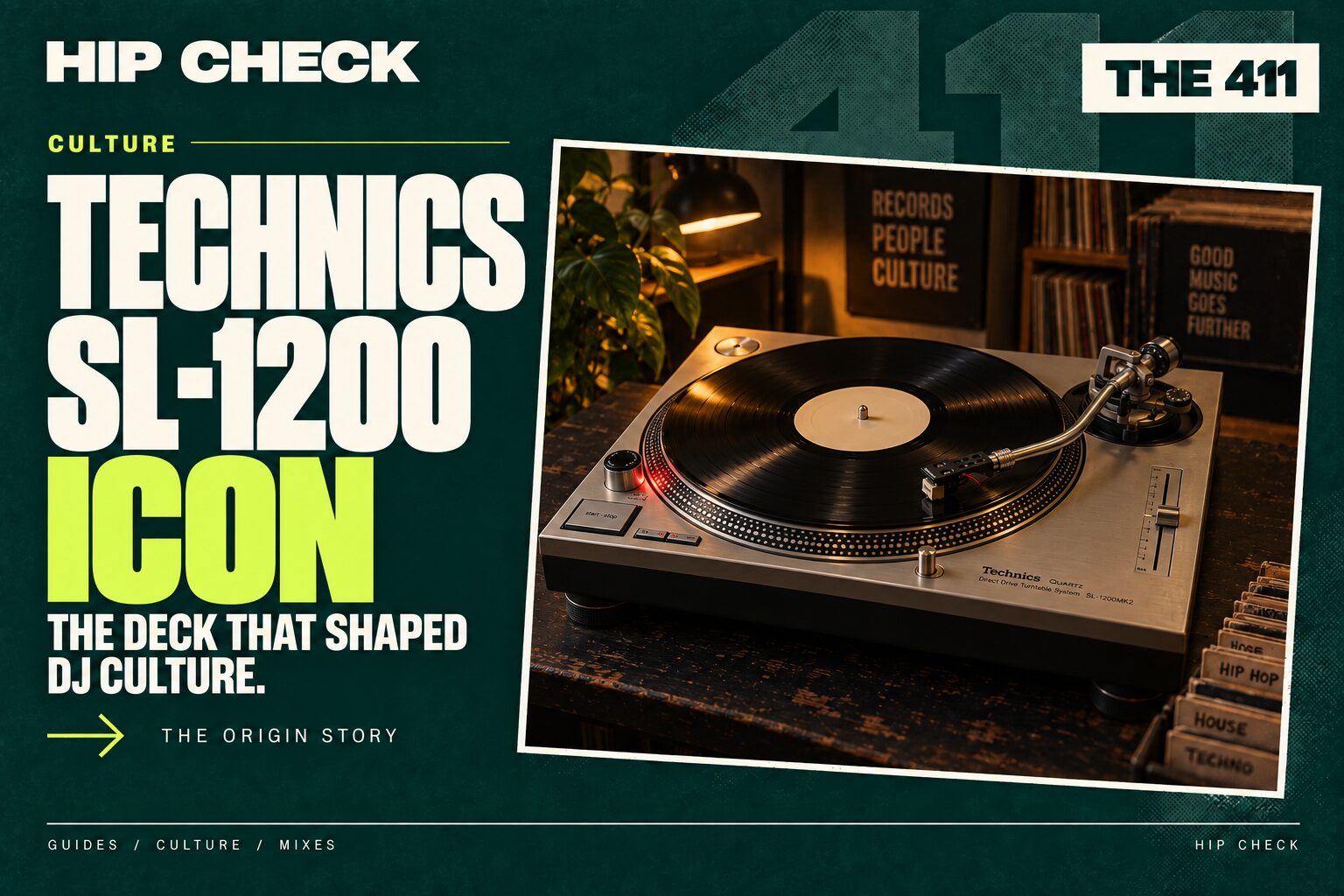
A silver deck. A dotted platter. A pitch slider within reach of your right hand. Few pieces of equipment communicate “DJ” as quickly as a Technics SL-1200.
Its reputation goes deeper than the look. The Technics SL-1200 became a DJ icon because stable direct-drive performance, practical controls and durable construction gave DJs a dependable platform for mixing and manipulating records. Repeated use across club and battle culture turned that platform into a shared reference point.
But the familiar story needs a little care. The original SL-1200 and the celebrated SL-1200MK2 arrived seven years apart. And the people who transformed DJing deserve as much attention as the machine beneath their hands.
1972: the original SL-1200 arrives
Technics launched the first SL-1200 in 1972. Its direct-drive motor sat in a compact, rugged aluminium die-cast body. The original model used a rotary pitch control, rather than the long slider most DJs now associate with the name.
It also had an important predecessor: the SP-10, introduced in 1970. The SL-1200 was not the first commercially available direct-drive turntable. It helped bring that technology into a format that found a lasting place with DJs. Technics’ official model history traces that development.
That distinction matters when looking at old photographs or buying vintage equipment. “SL-1200” can mean the first model, or it can be shorthand for a whole family of decks. The suffix tells you which generation you are looking at.
Why direct drive mattered in the booth
In a direct-drive turntable, the motor drives the platter directly, without a drive belt. For a DJ, the attraction is practical: predictable rotation makes it easier to judge whether two records are moving together.
Think about a blend in progress. You hear the incoming track falling behind, make a small correction and listen again. If the deck responds consistently, that correction becomes a skill you can repeat. The turntable does not do the beatmatching for you; it gives your ears and hands a dependable starting point.
The same relationship matters when cueing. You want to locate a sound, prepare its entry and release it with confidence. A slipmat lets the record move independently of the spinning platter during manipulation. Motor behaviour is only part of that experience: the mat, record, cartridge setup and the DJ’s touch matter too.
A useful deck is one you can learn to predict. That is a less glamorous explanation than “legendary sound”, but it gets much closer to what makes equipment valuable during a set.
1979: the MK2 listens to DJs
The SL-1200MK2 arrived in 1979. Technics says its staff visited clubs, gathered DJ feedback and used it to guide the redesign. Quartz-controlled rotation, a sliding pitch control and a revised vibration-absorbing construction were central changes. Source: Technics’ MK2 history.
The important idea was that the deck should suit a working DJ’s movements. A slider makes speed adjustments easy to see and revisit. A stylus light helps locate the needle in a dark booth. These are small details until you need to use them repeatedly, with music playing and another record waiting.
Technics’ guide to the series’ features identifies the MK2 as the introduction point for both the vertical pitch fader and the pop-up stylus light. Its familiar strobe and S-shaped tonearm also became part of the family’s visual identity.
The engineering and the appearance reinforce each other. You recognise the shape because you recognise the actions it invites: cue, release, adjust, listen.
Hip-hop gave the turntable a different job
Hip-hop’s turntable history is bigger than one model. Technics’ own account includes the earlier SL-1100 and its association with Kool Herc. It would be misleading to put a 1979 MK2 at the beginning of a culture already taking shape earlier in the decade. Read Technics’ club-culture history.
The deeper change was in how records were treated. A recording could become material to rearrange: a break to extend, a sound to repeat, a phrase to answer with another phrase. Scratching and beat juggling made the DJ’s physical decisions part of what the audience heard.
That is why describing the SL-1200 only as a record player misses its cultural meaning. In performance, the relationship between record, deck and mixer becomes expressive. The equipment supplies the controls; the DJ supplies the timing, selection and imagination.
The icon belongs to that relationship. Owning the deck does not grant the skill, and using another setup does not take the skill away.
DMC put turntable performance in the spotlight
DMC’s World DJ Championships began in 1985. Its own retrospective highlights DJ Cheese’s scratch-led victory in 1986 and later champions including Q-Bert, Mixmaster Mike, A-Trak, DJ Kentaro and C2C. The competition provided a stage on which turntable technique could become the main event. DMC’s account of its champions.
For a viewing companion, watch DJ Craze’s 1998 winning set on DMC World’s YouTube channel. This is an archival performance, rather than a beginner lesson. Watch it with a question in mind: when does the record stop functioning as a complete song and become something the DJ can play?
Battle culture also gives equipment a different kind of visibility. The audience sees the hands, hears the result and begins to associate a familiar setup with the possibilities of the craft.
From US clubs to a global DJ language
The SL-1200 story connects hip-hop with disco, house and techno, rather than belonging exclusively to one genre. Technics describes its growing international role through the 1980s and 1990s, as club culture spread and DJs needed consistent equipment from venue to venue. Source: Technics’ cultural history.
Our reading of that history is that familiarity became a strength of its own. A shared layout means less time learning a booth and more attention available for the music. A familiar pitch control or platter response can make an unfamiliar room feel a little more manageable.
That helps explain how a Japanese turntable could acquire meaning across US dance floors, European clubs and scenes farther afield. Different DJs wanted different results, but could build those results around the same physical language.
For one performer, that might mean a long blend. For another, a sharply timed cut. An icon does not need everyone to use it in the same way.
The name returned, but the models kept changing
Production of the established SL-1200 line ended in 2010. The story continued with a new generation: the SL-1200G launched in 2016, followed by the DJ-focused SL-1200/SL-1210MK7 in 2019. Technics documents the 2016 G launchand the MK7’s place in the series.
Do not read those names as a promise that every version is mechanically identical. A vintage MK2, a G-series hi-fi deck and an MK7 belong to the same lineage, but the model details and intended uses deserve their own attention.
If you want a visual introduction to those differences, watch Crossfader’s history of the Technics SL1200 and SL1210. Published in 2020, it is useful historical context rather than a guide to every subsequent release.
What the SL-1200 still teaches DJs
You do not have to play vinyl to take something from this history. The useful habits travel:
- Listen before correcting. Identify what is drifting before making another adjustment.
- Know your entry point. A confident release starts before the audience hears the next record.
- Make the controls familiar. Repetition frees attention for selection and the room.
- Let the music lead. Technique earns its place when it improves the moment.
Those ideas apply whether your next set uses records, media players or a controller. For a practical next step, read our guide to mixing hip-hop and R&B without clashing vocals.
The lasting appeal of the SL-1200 is easy to understand: it gives a physical shape to an otherwise invisible skill. You can see the record move, see the adjustment and hear the decision land.
Frequently asked questions
When was the Technics SL-1200 released?
The original arrived in 1972. The SL-1200MK2 followed in 1979. Those dates refer to different models, not two dates for the same launch.
Why is the SL-1200MK2 especially famous?
It brought DJ-informed changes to the original platform, including the sliding pitch control, quartz-controlled rotation and revised vibration damping. It became the reference point behind much of the series’ reputation.
Did the SL-1200 invent scratching or hip-hop?
No. DJs and communities developed the culture and techniques. The SL-1200 family became an important tool within that history; it should not replace the people in the story.
Do you need Technics turntables to be a good DJ?
No. Selection, timing, listening and practice matter on any capable setup. Understanding the SL-1200’s history explains its influence without making ownership a requirement.