
DJ Jazzy Jeff: The Skills Behind the Legend
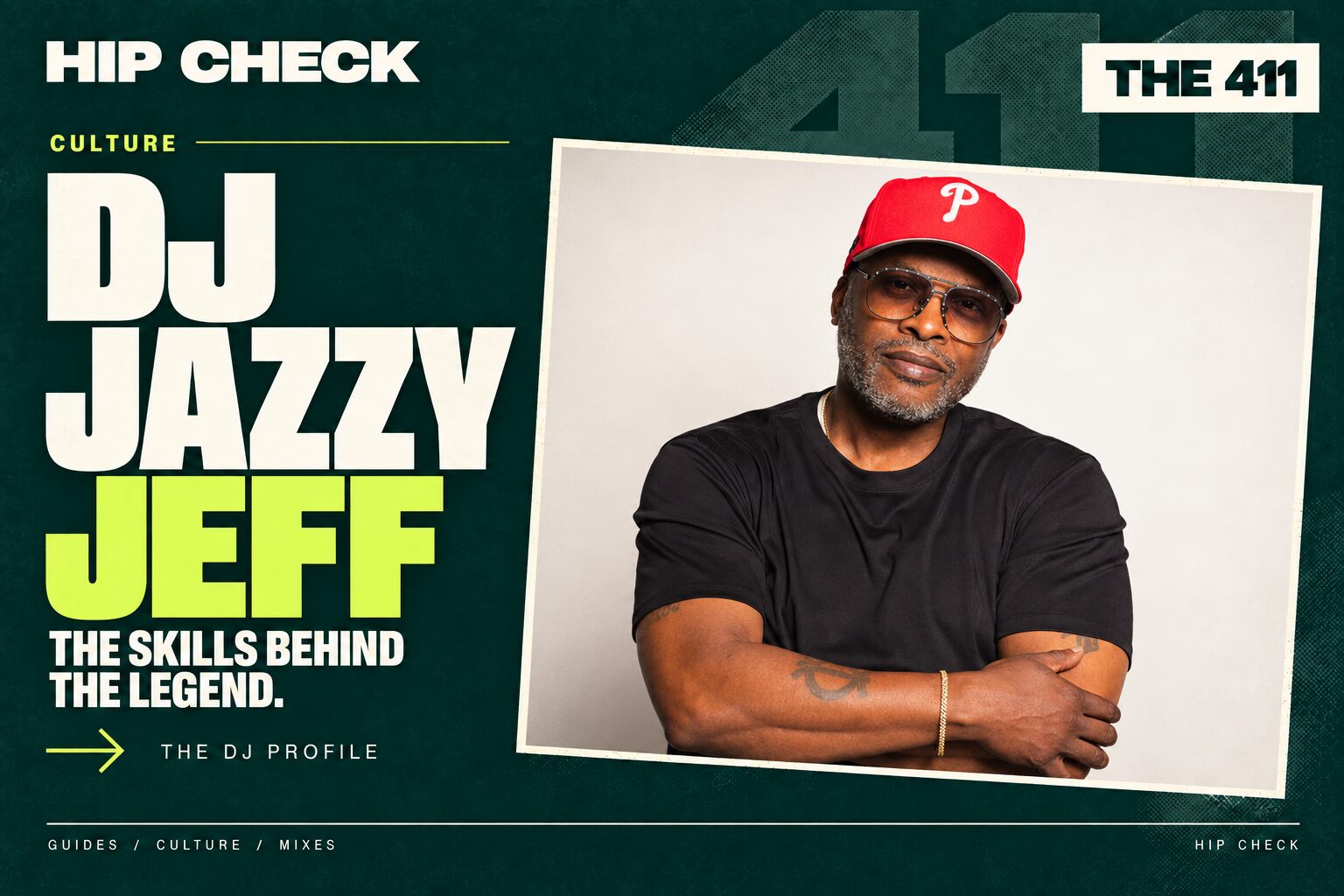
Put DJ Jazzy Jeff in front of a pair of decks and there is plenty for a DJ to study. The scratches get the attention. The bigger lesson is how technique, record knowledge and musical judgement fit together.
For Hip Check, that combination is what makes him such a useful reference point. Whether you play hip-hop, R&B or an open-format club set, studying Jeff gives you a reason to think beyond the next transition: what are you adding to the music, and when should you let the record speak?
Here is a guide to the skills behind his reputation, with three YouTube videos to explore and a practice session you can take back to your own setup.
From Philadelphia to hip-hop history
Jeff’s roots are in West Philadelphia and its block-party culture. His story connects the DJ’s role as a local party starter with the turntablist’s role as a performer. Serato’s artist profile traces those beginnings and credits him with helping popularise the transformer scratch.
Alongside Will Smith as DJ Jazzy Jeff & The Fresh Prince, he also became part of a landmark moment for recorded hip-hop. “Parents Just Don’t Understand” won Best Rap Performance at the 1989 GRAMMY Awards. “Summertime,” released in 1991, brought the duo another win in 1992, for Best Rap Performance By A Duo Or Group. The Recording Academy’s retrospective documents both awards.
Those records are an accessible entry point. To explore the DJ behind them, spend time with the routines, extended sets and studio footage too. Each format asks a different question of the same musician.
1. Scratching: listen for rhythm before speed
A scratch can function like a drum fill, a short reply or a burst of emphasis. Its value is in the rhythm and placement as much as the difficulty of the hand movement.
That is a useful way into Jeff’s turntablism. Instead of trying to identify every technique immediately, follow the pulse underneath the performance. Listen for where an intervention begins, how long it lasts and how the music feels when it ends.
Start with DJ Jazzy Jeff’s “Peter Piper” routine, filmed by Serato. It is a focused performance built around the Run-DMC track, rather than an entire club set. Serato’s published description identifies a setup combining turntables, a mixer, DJ software and a pad controller: this is also an opportunity to study how different controls contribute to a routine.
Watch with one question in mind: can you keep counting the beat while the routine unfolds? On a second pass, pay attention to the relationship between the hands and the sound. Avoid assuming every sound change comes from the record hand alone.
For your own practice, begin with a short, simple sound over an instrumental. Make a small rhythmic phrase, then leave a gap. Repeat it until you can place it deliberately. A clean phrase that lands where you intended is a more useful foundation than a complicated pattern you cannot repeat.
2. Selection: study the set beyond the highlight clip
A short routine and a long set are different listening experiences. One can concentrate attention on a single idea; the other has to sustain interest over time.
For the longer view, try DJ Jazzy Jeff’s Boiler Room x Budweiser Philadelphia DJ set. Boiler Room presents it as his debut for the platform, on home turf in Philadelphia, in a two-hour performance.
Use the set as a listening exercise. Pick an uninterrupted stretch and make a few notes:
- Which record draws your attention first, and why?
- Does the next selection feel like a continuation, a surprise or a reset?
- How much of a recognisable section do you want to hear before another change?
- Are you responding to the song itself, the transition or both?
These are prompts for your own assessment, rather than a prescribed reading of every transition. They are useful because a playlist can look convincing on paper while feeling awkward in sequence.
Try building a five-track run without using effects. Give each choice a purpose. You might move from a familiar hook into a related groove, then introduce something less obvious once the connection is established. Record the run and listen away from the decks: does it hold your attention when you cannot see what your hands are doing?
3. Record knowledge: know more than the first eight bars
There is a practical connection between collecting music and performing with it. Knowing the hook is useful. Knowing where the drums thin out, where the vocal pauses and where a distinctive sound returns gives you far more options.
For working DJs, that means preparing songs as pieces of music rather than treating them as interchangeable files at a matching BPM. A tempo match can help two tracks line up; it cannot decide whether two lead vocals make sense together.
Choose ten tracks you already love and map their useful moments. Mark the first clear downbeat, the beginning of the chorus, an instrumental passage and a possible exit. Listen through the whole track before trusting those markers.
Then test two different transitions between the same songs. Let one play out naturally and make the other shorter. The aim is to learn which arrangement serves the pairing, rather than deciding that one transition length is always correct.
For more on keeping vocals clear, read our guide to mixing hip-hop and R&B without clashing vocals.
4. Production: hear possibilities inside a record
Jeff’s work also reaches into production. Mass Appeal’s “Rhythm Roulette: DJ Jazzy Jeff — Serato Edition” follows a sample-based studio session, with records brought by Gene Brown and Serato Sample used in the process. It is a different setting from the booth, but another useful window into musical decision-making.
As you watch, consider what makes a fragment worth developing. Is it a melodic detail, the texture of the recording or a rhythmic idea? Pay attention to the move from choosing material to giving it a new context.
You do not have to become a producer to bring that curiosity into DJing. Listen beyond the most obvious part of a song. A brief drum passage or instrumental phrase may suggest a transition you would miss by skipping straight to the chorus.
Try this: take one track from your own collection and identify three different reasons you might play it. One might be the vocal, another the groove, and another a moment that connects with a second record. That is three programming ideas from one piece of music.
5. Adaptability: keep learning your tools
Jeff’s association with Serato is documented in its artist profile and interviews. His career offers a useful starting point for a discussion about moving between traditional turntable skills and digital tools.
For your own setup, the productive question is what a feature lets you do musically. Can you reach a useful section reliably? Can you repeat an idea cleanly? Can you prepare the next record without losing track of the one the audience is hearing?
Choose one feature and practise it in context. A cue point or loop becomes useful when you know why you want it, how it sounds and how to leave it smoothly. More available controls do not automatically make a better performance.
A 30-minute practice session for your next mix
These are Hip Check exercises inspired by the themes above, not lessons supplied or endorsed by Jazzy Jeff.
- Five minutes: listen. Choose a short passage from one of the linked videos. Write down one question about the musical decisions, rather than trying to copy everything.
- Ten minutes: control. Over an instrumental, repeat one simple rhythmic idea. This could be a scratch phrase or a short cue-point pattern. Leave space between repetitions and keep the underlying pulse steady.
- Ten minutes: selection. Mix three tracks with a clear connection. Concentrate on phrasing, vocal space and consistent listening levels.
- Five minutes: review. Play back your recording. Identify one moment that improved the flow and one you would simplify. Use those observations to plan the next session.
DJ Jazzy Jeff: quick questions
Did Jazzy Jeff invent the transformer scratch?
It is more accurate to say he helped popularise it. That is the wording used by Serato’s artist biography. Giving one person sole credit for an evolving DJ technique can obscure the wider scene that developed it.
Which Jazzy Jeff video should I watch first?
Start with the “Peter Piper” routine for a focused performance. Follow it with the Philadelphia Boiler Room set for a longer listening session, then “Rhythm Roulette” for the production angle. All three are linked above.
Do I need turntables to learn from his DJing?
You can study selection, phrasing and musical timing on any suitable DJ setup. Recreating a particular turntable movement is a separate task from learning how a musical idea fits into a set. Begin with the skills your equipment lets you practise reliably.
Keep exploring through DJ Jazzy Jeff’s official website. Then return to your own collection, choose three records and see how much you can say with them.