
Wireless Headphones for DJs: What the AlphaTheta HDJ-F9 Changes
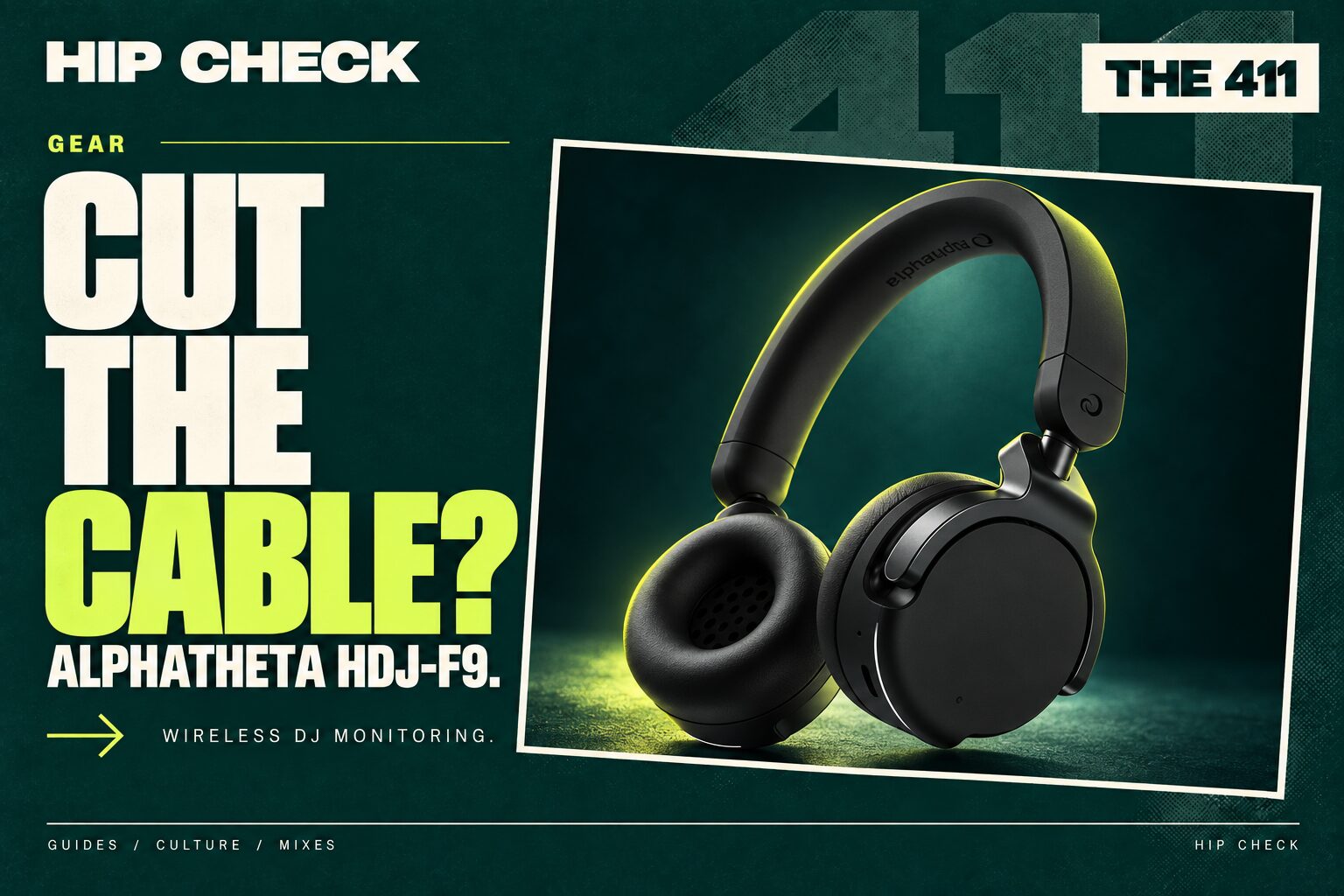
Wireless headphones sound attractive until you try to line up a kick drum and hear the cue arrive late. For hip-hop and open-format DJs who make quick transitions, cue repeatedly or scratch, timing is the first question.
AlphaTheta announced the HDJ-F9 wireless on-ear DJ headphones on 15 October 2026. They use its SonicLink system for DJ monitoring and also offer Bluetooth for other listening. The important distinction is the connection you use—not simply whether a cable is attached. Read the official announcement.
This is a launch explainer, not a hands-on review. The specifications below are AlphaTheta’s published claims. We have not independently measured latency, battery life, isolation or connection reliability.
SonicLink and Bluetooth do different jobs
AlphaTheta specifies SonicLink latency as low as 9ms. The system is intended for monitoring while DJing; the product’s Bluetooth capability should not be treated as an interchangeable connection for the same task. Its product page explicitly contrasts SonicLink with the greater delay associated with standard Bluetooth codecs.
For a DJ, delay matters because you are comparing events in time. You might be listening to the cue in one ear and a booth monitor with the other, or checking a scratch against the playing deck. A delayed cue changes that relationship. The whole setup matters too: headphone transmission is not the only possible source of delay between your action and the sound you hear.
The useful test is therefore your own routine on your normal equipment. A low headline figure is encouraging, but it is not a substitute for checking the complete signal path.
How would the HDJ-F9 connect to your setup?
The announcement describes touch pairing with compatible equipment such as the DJM-V5, which needs the appropriate firmware. For a wider range of equipment, AlphaTheta points to its separately sold HP-TX01 SonicLink transmitter. Do not assume your existing mixer or controller transmits SonicLink just because it has a headphone output.
Before buying, identify the exact mixer or controller you use, whether it has native support, and which additional transmitter and connections would be required. If you regularly move between venues, consider the extra setup step as part of the decision. A convenient system at home may feel different during a hurried booth changeover.
Watch AlphaTheta’s official HDJ-F9 video alongside the product documentation. It is a manufacturer demonstration, rather than independent testing.
The specifications worth checking
| Feature | Published detail | Why a DJ should care |
|---|---|---|
| Design | On-ear, closed dynamic headphones | Try the fit with your preferred one-ear or two-ear monitoring style. |
| Drivers | 40mm | Driver size alone does not establish how clearly you will hear cue details. |
| SonicLink battery | Up to 9 hours with the status LED off; approximately 7 with it on | Build charging margin around soundcheck, preparation and the full booking. |
| Charging | Approximately 2.5 hours for a full charge | A quick top-up and a fully charged headset are different plans. |
| Wired option | Included coiled cable and stereo plug adapter | Keep the fallback available in your bag. |
Specifications: HDJ-F9 product page. Battery figures depend on conditions; they should not be read as a guaranteed duration at every listening level.
What this could change for hip-hop and open-format DJs
More freedom around the booth. Removing the headphone lead may make it easier to move between decks, a laptop and a microphone. Whether that helps depends on your own setup. If you rarely move and like a wired connection, the practical benefit may be modest.
A different routine to manage. You exchange cable management for charging, pairing and checking the wireless link. Those tasks need a place in your pre-gig preparation, especially when you are playing back-to-back with another DJ.
Potentially useful for performance-heavy sets. DJs who switch monitoring positions repeatedly should try the fit while cueing and cutting, not just while listening to a finished track. Comfort during a short shop demonstration may not predict comfort through a whole booking.
None of these points makes wireless automatically better. They are the practical questions that determine whether it improves your working routine.
A sensible test before taking wireless headphones to a gig
- Compare against a familiar wired pair. Use the same mixer, cue balance and a sensible listening level.
- Run your actual transitions. Test manual beatmatching, quick cue starts and any scratch patterns you use. Do not judge solely with sync engaged.
- Check monitoring positions. Try one ear, both ears and the position you use while working the microphone.
- Move as you normally would. Keep the test realistic for a booth rather than treating maximum advertised range as the goal.
- Practise the fallback. Know how you would return to the supplied cable without a long interruption to your cueing.
- Include charging in your checklist. Start with enough margin for preparation and delays, not just the advertised set length.
Should you replace your wired headphones?
The HDJ-F9 gives DJs a concrete reason to examine wireless monitoring, but a purchase should solve a problem you actually have. If a lead frequently gets in your way, the concept may be attractive. If your current pair is comfortable, dependable and easy to hear in the booth, there is no need to replace it simply because a new model exists.
Check the complete system cost in your region, including any transmitter you need, and seek a demonstration or a suitable return policy. We would want independent performance testing before making a stronger recommendation about reliability in busy venues.
For now, the useful takeaway is to distinguish purpose-built wireless DJ monitoring from ordinary Bluetooth listening. Compare the setup, not just the headline. Explore more equipment and technique guides in THE 411.
Information checked on 20 October 2026 against AlphaTheta’s announcement and product page. Product specifications and compatibility may change. The hero is an editorial illustration based on the manufacturer’s product imagery.