
Early Days of New York Hip Hop
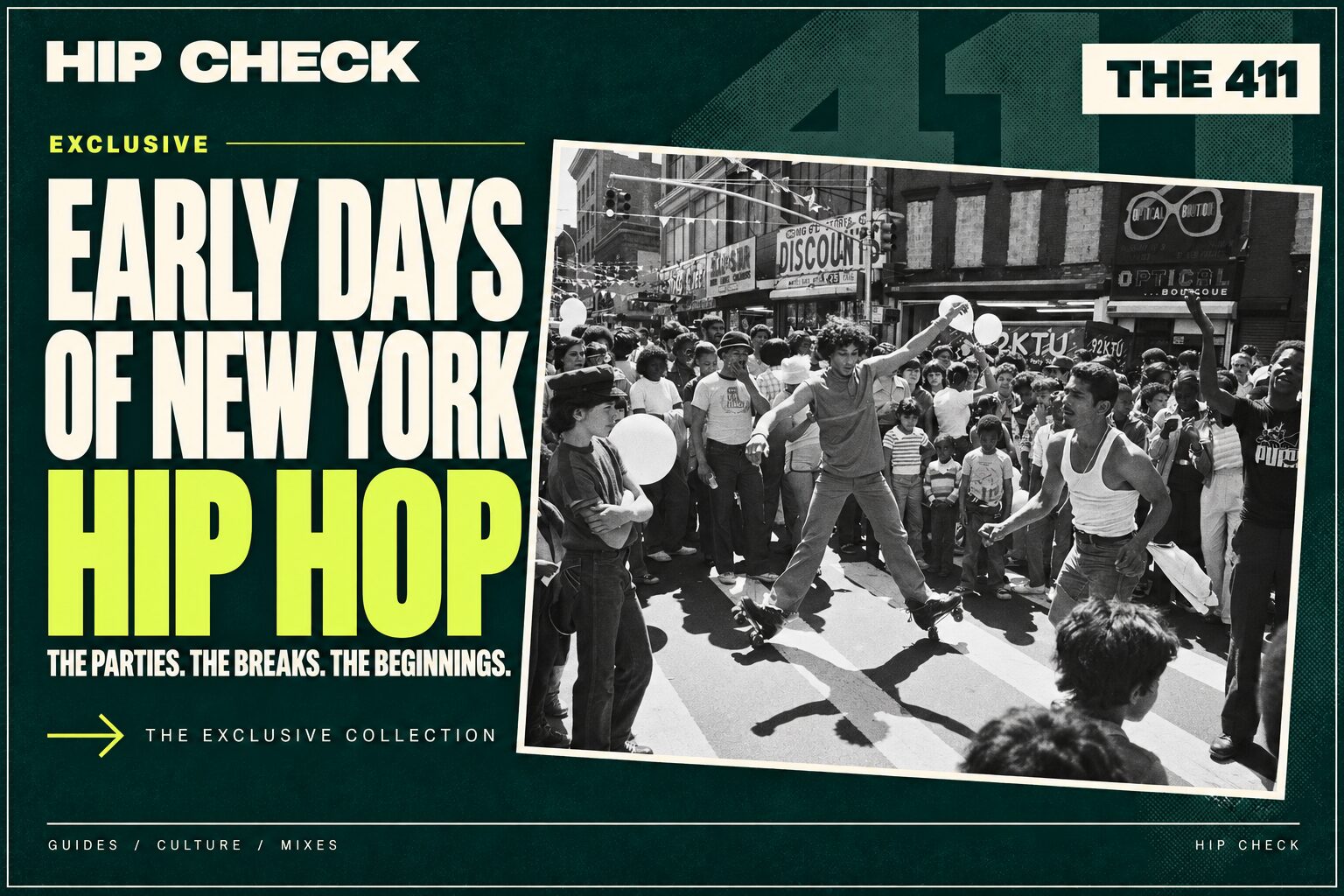
Before hip-hop became a global industry, it was a reason to gather: a DJ holding the groove, a microphone passing between voices and a crowd deciding what worked. Early Days of New York Hip Hop brings that spirit into your library with a 16-file collection for DJs who want to explore beyond the obvious throwback selections. Start with the familiar feeling of a party in motion, then discover the records that could give your next set a different direction.
EXCLUSIVE COLLECTION
Dig deeper into the early party sound. Access all 16 MP3s with an active paid Hip Check membership.
Paid members only
Upgrade your membership to preview and download this collection.
Already a paid member? Log in.
Early New York hip-hop: the party came first
Hip-hop grew through a living culture of DJing, MCing, dancing and visual expression. The Bronx party organised by Cindy Campbell and her brother Kool Herc at 1520 Sedgwick Avenue on 11 August 1973 is a widely recognised landmark. The National Archives’ history of hip-hop traces those beginnings and the importance of funk, disco and soul to the music.
For a working DJ, the useful lesson is the attention paid to dancers. A compelling groove could become the centre of the room; an MC could turn listeners into participants. That relationship between selection, repetition and response still matters when you play an open-format set today.
Inside the Early Days of New York Hip Hop collection
The folder contains 16 MP3 files, with Cold Crush Brothers, Spyder D and T-Ski Valley among the artists represented. Those are a few starting points, rather than a public track-by-track reveal. The full selection is available through the paid-member download above.
Think of the pack as a collection centred on early New York hip-hop and its wider musical connections. It is not a claim that every artist or recording originated in the city, nor a complete chronological history. That broader perspective makes room for discovering how related sounds can work alongside one another in your own crate.
Give your old-school hip-hop sets more character
A greatest-hits run has its place. A deeper selection gives you another option: a warm-up with personality, a short history-inspired passage in a mix, or a bridge between a funk section and a rap set. These are programming ideas to test against your audience, not a promise that every recording belongs at peak time.
Try building a three-record passage around a shared rhythmic feel. Establish a groove the room understands, introduce a less familiar selection, then return to a recognisable musical direction. You can make discovery feel inviting without turning the set into a lecture. Let the crowd’s response guide how far you go.
Prepare the files before taking them into the booth
- Listen beyond the opening. Mark where the main vocal arrives, where the rhythm opens up and where a useful exit occurs. Keep competing MC passages apart.
- Check the beatgrid by ear. Do not assume older recordings hold a perfectly fixed tempo. If a passage drifts, use a shorter blend or ride the pitch rather than trusting a long automated transition.
- Match perceived loudness. Preview levels alongside your usual library and adjust gain thoughtfully. A quieter master does not need to be pushed into the red.
- Check the supplied version. Review language, arrangement, stereo or mono presentation and audio quality yourself. This collection is supplied as MP3s; do not assume every file is a clean version, remaster or extended DJ edit.
Explore the culture behind the music
To see the world around the records, explore the Cornell Hip Hop Collection’s digital archives. Its early event flyers and Joe Conzo photographs document the people, places and gatherings behind the culture. Conzo’s archive includes South Bronx life and hip-hop’s emergence between 1976 and 1984.
That visual history is a useful companion to listening. Look at how a party was presented, then think about how you introduce older music to a new room. Context can deepen a selection without requiring a long explanation on the microphone.
Unlock the collection and build your own story
The next record that gives your set its personality may be one you have not explored yet. Early Days of New York Hip Hop offers a focused place to start: 16 files to audition, organise and work into your own approach. Active paid members can access the collection below. If you are on a free trial or have not joined, choose a paid Hip Check membership to unlock the download.
EXCLUSIVE COLLECTION
Dig deeper into the early party sound. Access all 16 MP3s with an active paid Hip Check membership.
Paid members only
Upgrade your membership to preview and download this collection.
Already a paid member? Log in.